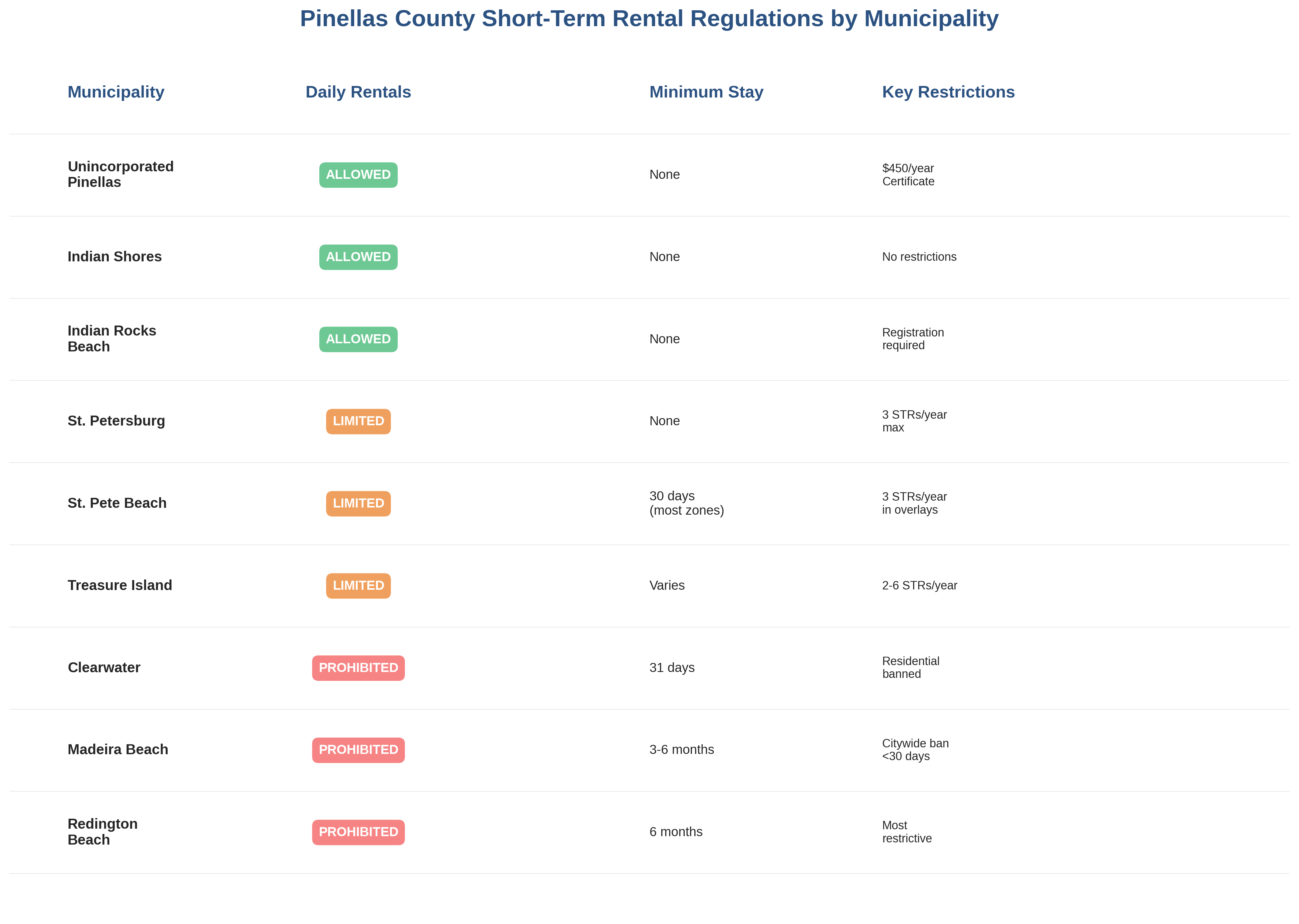
Short-term rental regulations across Pinellas County's 24 municipalities vary dramatically—from daily rentals with minimal restrictions in Indian Shores to six-month minimums in Redington Beach. Clearwater actually prohibits rentals under 31 days in residential zones, while Indian Rocks Beach and Indian Shores permit unrestricted daily rentals. The county adopted sweeping new regulations in March 2025, and ongoing legal battles continue reshaping the regulatory landscape.
Whether you're considering investing in Tampa Bay real estate or already operating vacation rentals, understanding 2026's compliance requirements is critical to protecting your investment.

Which municipalities actually allow daily rentals
The regulatory picture is more nuanced than commonly understood. Three categories emerge across Pinellas County:
Communities allowing daily rentals without frequency limits:
- Unincorporated Pinellas County: No minimum stay, subject to Certificate of Use program (implemented 2025)
- Indian Rocks Beach: No minimum stay with comprehensive 2023 ordinance requiring registration
- Indian Shores: No rental restrictions in town code
Communities with frequency caps on short stays:
- St. Petersburg: Allows up to 3 short-term rentals per year (under 30 days) in most residential zones; unlimited STRs in RM zones, Pass-A-Grille Overlay, Downtown Center, and Commercial General districts
- Treasure Island: RU-75 zones allow 2 occupancy changes per year; RM-15 allows 6 per year; commercial zones unrestricted
- St. Pete Beach: Most zones require 30-day minimum; RM zone and Pass-A-Grille Overlay allow up to 3 short-term rentals per year
Communities with strict minimum stay requirements:
- Clearwater/Clearwater Beach: 31-day minimum in all residential zones; only Tourist and Commercial districts allow short-term rentals
- Madeira Beach: 6-month minimum in R1 zones, 3-month minimum in R2 zones; rentals under 30 days prohibited citywide
- Redington Beach: 181-day (6-month) minimum—the most restrictive in the county
- Redington Shores: 181-day minimum in RS zones; 30-day minimum in RM/RD zones
- South Pasadena: 30-day minimum
Investors exploring St. Petersburg neighborhoods or Clearwater properties must verify zoning before purchasing—the difference between an Indian Shores property and a Redington Beach property represents fundamentally different investment models.
Unincorporated Pinellas County's Certificate of Use program
The Board of County Commissioners adopted Ordinance 25-15 on March 25, 2025, creating the most comprehensive STR program in the county's history. Approximately 2,200 properties in unincorporated areas must now comply with the ongoing Certificate of Use requirements.

Certificate of Use requirements:
| Element | Requirement |
|---|---|
| Annual fee | $450 |
| Initial inspection | $150 |
| Re-inspection (biennial) | $100 |
| Renewal | Annual renewal required |
Occupancy formula: 2 guests per bedroom plus 2 additional guests in one common area, with a hard cap of 10 occupants regardless of property size. Children of all ages count toward occupancy—the previous exemption for children under 12 was removed.
Safety inspections verify smoke alarms, carbon monoxide detectors, emergency egress windows (minimum 5.7 square feet net clear opening), fire extinguishers (2A:10B:C rating), and pool safety compliance. Properties had through 2026 to bring non-compliant egress windows into compliance.
For complete details on inspection requirements, see the Pinellas County STR Certificate of Use Program.
Zoning requirements across key municipalities
Zoning determines everything in Pinellas County STR operations. Each municipality maintains distinct district classifications:
Clearwater operates under a blanket residential prohibition. Community Development Code Sections 1-104.B and 3-919 explicitly prohibit rentals under 31 days in all residential districts. Only 31 properties grandfathered from a 2007 court ruling may legally operate daily rentals in residential areas. Tourist District (T) and Commercial District (C) properties may operate with a Business Tax Receipt.
St. Petersburg's Land Development Regulations create a tiered system. Neighborhood Traditional (NT), Neighborhood Suburban (NS), and similar zones permit only 3 short-term stays per 12-month period. Properties seeking more frequent rentals can apply for Resort Facilities Overlay approval—a 5-6 month process with a $2,400 fee. RM (Residential Multi-family) and Downtown Center zones allow transient occupancy without the 3-rental cap.
Indian Rocks Beach permits STRs across all zones but imposed comprehensive regulations through Ordinance 2023-02 (effective August 1, 2023). Maximum occupancy ranges from 10-12 guests, with parking requirements of one space per bedroom and noise limits of 60 dB daytime/55 dB nighttime.
Property buyers should consult the Florida Department of Business and Professional Regulation for state-level licensing requirements and the Pinellas Realtor STR guide for municipal contact information.
Permit processes, fees, and registration requirements
Every STR operator in Pinellas County must navigate multiple layers of registration:
State-level requirements:
- Florida DBPR license (vacation rental dwelling/condo) — $50 application plus $10 training fee
- Florida Department of Revenue sales tax certificate
- Balcony safety inspections every 3 years for buildings with 3+ stories
County-level requirements:
- Pinellas County Tourist Development Tax registration (contact: touristtax@pinellastaxcollector.gov)
- Business Tax Receipt from Tax Collector — starting at $22 for single units
- Certificate of Use for unincorporated areas — $450 annually plus inspection fees
Municipal requirements vary: Clearwater requires a Business Tax Receipt ($50-200 range) plus a designated local representative within Pinellas, Hillsborough, Pasco, Manatee, or Sarasota counties. St. Petersburg requires BTR with annual September 30 expiration; operating without one triggers a 25% penalty plus minimum $50 late fee.
Tourist development tax and total tax burden
Pinellas County is one of only five Florida counties certified as "high tourism impact," authorizing the maximum 6% Tourist Development Tax on all rentals of six months or less.

Complete tax breakdown:
| Tax Type | Rate |
|---|---|
| Florida state sales tax | 6% |
| Pinellas County surtax | 1% |
| Tourist Development Tax | 6% |
| Total guest tax | 13% |
Major platforms including Airbnb (since December 2015) and VRBO/HomeAway (since October 2018) automatically collect and remit both state and county taxes. However, property owners remain ultimately liable if platforms fail to collect. Returns must be filed monthly (or quarterly if under $300), and zero-tax returns are mandatory even with no rental activity. Late filing triggers a minimum $50 penalty regardless of tax owed.
Visit the Pinellas County Tax Collector for registration details and the Florida Department of Revenue for sales tax information.
Operational restrictions across the county
Consistent operational standards now apply throughout unincorporated Pinellas County, with municipalities enforcing similar or stricter requirements:
Parking: One off-street space per 3 guests (rounded up), with each space measuring minimum 8 feet × 18 feet. Front lawn parking does not count toward minimum requirements—only paved driveways and garages qualify.
Quiet hours: 10:00 PM to 9:00 AM daily, strictly enforced. Pinellas County uses decibel control: 72 dBA during daytime, 55 dBA after 10 PM in residential areas.
Required guest notice posting: Operators must display a single-page notice containing owner/representative contact information, maximum occupancy, parking layout, trash pickup days, quiet hours, and nearest hospital location.
Fire safety: Gas grills, fire pits, and smokers must be used at least 10 feet from any structure.
Recent regulatory changes transforming the market
The 2023-2025 period saw unprecedented regulatory activity:

March 2025 — Pinellas County adopted comprehensive STR ordinance after public hearings revealed a 200-300% increase in code enforcement complaints. The county identified nearly 18,000 short-term rentals countywide, with numbers growing 25% in one year.
June 2024 — Governor DeSantis vetoed Senate Bill 280, which would have created a statewide vacation rental registry and preempted local zoning rules on rental frequency and duration. The veto preserved local governments' ability to enforce existing ordinances.
2023-2025 — Indian Rocks Beach's comprehensive ordinance triggered seven federal lawsuits and litigation from approximately 300 property owners. The city rejected an August 2024 settlement proposal and voted in March 2025 to continue defending the ordinance despite estimated $800,000 in legal fees.
The 2011 Florida state preemption law (with 2014 amendments) continues limiting what local governments can regulate—prohibitions on duration or frequency of stays are generally not permitted unless the local ordinance predates June 1, 2011. However, localities retain authority over registration, fees, inspections, occupancy limits, parking, noise, and nuisance controls.
Enforcement has intensified significantly
Pinellas County hired three new code enforcement officers plus one supervisor dedicated to STR compliance, focusing on 4 PM to midnight Friday through Sunday. The county deployed tracking software to identify non-compliant advertisements.
Violation penalties (unincorporated county):
- First offense: $150
- Second offense: $300
- Third and subsequent: $500 per day
Redington Shores imposes $500 per day for transient rental violations, including advertising properties for transient rental on the internet. St. Petersburg can levy fines up to $1,000/day for repeat violations and $10,000 "super fines" for egregious cases.
The 24/7 STR Complaint Hotline (727) 353-2436 and online portal at pinellas.gov/strcomplaint now provide neighbors direct enforcement access.
Related Resources
Internal Guides:
- Tampa Bay Real Estate Market 2025: Complete Investment Guide
- First-Time Home Buyer Guide for St. Petersburg
- Downtown St. Pete Real Estate: Buyer's Guide 2025
- Clearwater Beach Property Market Analysis 2025
- Tampa Bay Home Buying Guide 2025
- Clearwater Home Buying Guide 2025
External Resources:
- Pinellas County STR Certificate of Use Program
- Florida DBPR Vacation Rental Licensing
- Pinellas County Tax Collector - Tourist Development Tax
- Tampa Bay Beaches Chamber - STR Advocacy
- St. Pete Beach STR Rules & Regulations
- Indian Rocks Beach Vacation Rental Information
- Town of Redington Shores Rental Regulations
- Pinellas Realtor Association - STR Contacts
Conclusion
Pinellas County's STR landscape requires careful navigation. Property investors should verify zoning through municipal planning departments and the county's "My Neighborhood" tool before purchasing—the difference between an Indian Shores property (no restrictions) and a Redington Beach property (6-month minimum) represents fundamentally different investment theses.
The March 2025 county ordinance established a baseline for unincorporated areas, while ongoing litigation in Indian Rocks Beach continues to reshape the boundaries of local regulatory authority. Operators must maintain compliance across all three levels—state DBPR licensing, county TDT registration and Certificate of Use, and municipal Business Tax Receipts—while collecting and remitting the full 13% tax burden.
For Tampa Bay investment opportunities or guidance on navigating these complex regulations, contact Mangrove Bay Realty.
📞 Call us: (727) 625-1777
📧 Email: troynowakrealty@gmail.com
🌐 Visit: mangrovebayrealty.com
Author: Troy Nowak, Licensed Florida Real Estate Broker
Office: 330 3rd Street South, St. Petersburg, FL 33701
Disclaimer: This guide provides general information about Pinellas County short-term rental regulations as of January 2026. Regulations change frequently and vary by municipality. Always verify current requirements with local authorities and consult legal, tax, and real estate professionals before making investment decisions. This content does not constitute legal, financial, or tax advice.